
New Delhi must look for formal, institutional statements issued directly from Washington rather than rely on casual pronouncements meant for local audiences, notes Ambassador Rajasekhar.
China and Pakistan concluded their strategic dialogue, reiterating their opposition to unilateral actions in South Asia and discussing Kashmir, Afghanistan, and trilateral cooperation.

Through his commitment to democratic norms, debate, dissent and constitutionalism, Jawaharlal Nehru helped ensure that parliamentary democracy took deep root in independent India. Utkarsh Mishra evaluates Nehru's 17 years as India's first prime minister, examining his role in nation-building, democratic institution-building, economic planning, scientific advancement and foreign policy.

'I suspect that Bangladesh being given permission stuck in India's official craw, and this story was an attempt to balance the scales by giving the impression that a similar waiver had been given to India as well.'

Egypt, Pakistan, Saudi Arabia and Turkey met in Islamabad in what analysts say is the formal opening of a new diplomatic formation that could reshape the post-war regional order. Their immediate goal is a ceasefire; their larger ambition is to ensure that neither Iran nor Israel emerges from this war in a dominant position. Pakistan's foreign minister then flew directly to Beijing and mooted a Chinese role as guarantor of any eventual agreement. Prem Panicker continues his must read daily blog on the Gulf War.
An influential US lawmaker claims his visit to India helped catalyze "early signals" that New Delhi may reduce its imports of Russian oil, a step he described as "meaningful" in weakening Moscow's ability to fund its war in Ukraine.
'These efforts by Beijing can be weaponised one day with economic, security and political implications for India.'

Pakistan's Air Force Chief Zaheer Ahmed Baber Sidhu visited the US to enhance bilateral defence cooperation, following a similar visit by the Army Chief. The visit included meetings with US military and political leaders to discuss regional security, counter-terrorism efforts, and future cooperation.

Engagement with neighbours is a strategic imperative, and not an option, asserts Rup Narayan Das.

The Singapore Minister applauded Prime Minister Modi's effort to make India the manufacturing hub of the world.
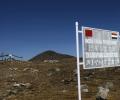
India has been rejecting China renaming places in Arunachal Pradesh, asserting that the state is an integral part of the country and assigning "invented" names does not alter this reality.

He cited the US-backed regime changes or "colour revolutions" in former Soviet Republics like Georgia, Ukraine and Kyrgyzstan as events that could have an impact on China's security calculations.

Times have changed, situations have changed, but the basic nature of superpower geo-politics remains the same and so also India's diplomacy -- call it non-alignment, strategic autonomy or neutrality; it all depends on the time scale, notes Rup Narayan Das.

Modi attended the 20th ASEAN-India Summit in Jakarta. Secretary-General of ASEAN Dr Kao Kim Hourn also attended the summit.

The scaling up of the India-US strategic partnership to the level of non-NATO ally with defence deals, sharing and transfer of defence technology, interoperability, joint collaboration and joint production of defence equipment has exacerbated Moscow's anxiety, notes Rup Narayan Das.

India would not be seen to be anything but rude with the Pakistanis. In the big picture, who is the bigger adversary right now? Who is the bigger pain in the neck? And who is it that is keeping more than 3,000 km of our borders active, throwing our military posture and deployments into imbalance? asks Shekhar Gupta.
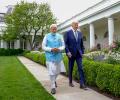
'India will want a lot of help from the US, but it's not going to want US troops.'
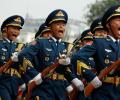
'We are beginning to see that the rest of the world will not simply accept the domination of one power'

'Pleasure to meet FM Sergey Lavrov, this time in person. Excellent talks that reflect our Special and Privileged Strategic Partnership. Value our exchanges on the international situation,' Jaishankar tweeted after talks with his Russian counterpart on the sidelines of the SCO meeting.
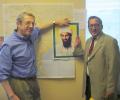
'Steve was the foremost strategic analyst on South Asia,' remembers Colonel Anil A Athale (retd).
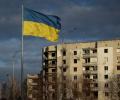
Only the future will tell if Modi can leave his mark on the Ukraine crisis. Nonetheless, it is both a challenge and an opportunity for India's diplomacy, notes Rup Narayan Das.

Prime Minister Narendra Modi is likely to announce a host of initiatives for the health sector on Independence Day with the highlights being the 'Heal in India' and 'Heal by India' projects and a roadmap to eliminate sickle cell disease by 2047, official sources said.
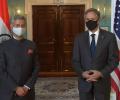
Blinken is scheduled to arrive in New Delhi late on July 27. He is scheduled to attend a full slate of engagements on July 28. During his stay in the country, he will meet Prime Minister Narendra Modi and External Affairs Minister S Jaishankar.

'The US-India relationship is in a different league altogether,' Obama administration officials tell Aziz Haniffa/Rediff.com in Washington, DC.

If smart enough, India should befriend China and respect Pakistan, preventing disputes from spilling over, the article said.
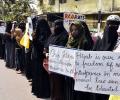
India and Indians can ignore Pakistan, but that cannot be said of other nations in the neighbourhood, where New Delhi's 'Neighbourhood First' policy constantly reverberates. Four of the eight SAARC member-nations are Muslim -- Afghanistan and Pakistan, Bangladesh and the Maldives. The rulers decide the nation's India or anti-India policy in the first two, and street-opinion contributes to the same in the latter two, points out N Sathiya Moorthy.

President Pranab's four-day visit to China that saw him meeting the top Chinese leadership and discussing the sticky boundary issue and cooperation in combating terrorism besides the need for a predictable nuclear regime.
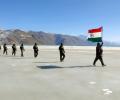
India has told China not to "shift goalposts" and "confuse" managing the border affairs and restoring peace at the frontiers with the larger issue of the resolution of the boundary question, which is dealt with by different designated mechanisms.

India provides an intrinsic and important link between the developing and the developed world, and maintains a distinct relationship with the United States and China on individual basis, says External Affairs Minister Salman Khurshid.
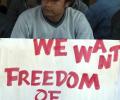
'This includes increasing restrictions on freedom of expression and the detention of human rights activists and journalists'

The Border Security Force has been put on high alert along the India-Bangladesh border in Assam and Tripura following intelligence inputs of Islamic terrorists planning to infiltrate the country.
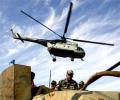
Prime Minister Narendra Modi's initial weeks in office and the composition of his national security team give a sense of his government's foreign policy and national security priorities, says Harsh V Pant

'It seems that the BJP in its desire to catapult Modi onto the international stage, knowing the image deficit due to visa denials, has caused unhappiness in Tamil Nadu, uncertainty in Bangladesh and a churning in Pakistan that Sharif may or may not be able to control,' says Ambassador K C Singh.
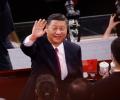
Xi arrived at the Nyingchi Mainling Airport on Wednesday and was warmly welcomed by local people and officials of various ethnic groups, Xinhua news agency reported.
.jpg)
Beating of war drums, would further accord primacy to the army in Pakistan. A better approach would be to continue the talks for normalisation of trade relations, while giving the Indian forces autonomy to strike at militant camps across the LoC, says Alok Bansal

'In the time I have been an Indiawallah, I have seen three US Presidential visits to India, nuclear sanctions, nuclear cooperation, a border conflict with Pakistan, the growth of IT services, a government losing a confidence vote, and so much more,' Rick Rossow, the new Wadhwani Chair in US-India Policy Studies tells Rediff.com's Aziz Haniffa.

At a time when China is trying to make its foray into South Asia, India should use its shared history to strengthen its ties in the region, says Dr Rup Narayan Das.
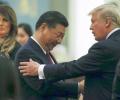
'While many Chinese policy makers dismiss the political, economic and technological component of US-India relations, they express caution on the defence-related ties which also happens to be a major driver in US-India relations,' explains China expert Srikanth Kondapalli.

Access to Sabang Port will allow the Indian Navy to dominate Malacca Strait more effectively, reports Ajai Shukla.
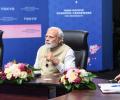
As US President Joe Biden launched a new trade deal with 12 Indo-Pacific nations, including India, to enhance trade, economic and investment opportunities, China, which sees the pact as a threat to its dominance in the region, went on the offensive against it, promising more opening up, while the official media here termed it as "economic Nato".
